
The Customer Is Always Right (About To Get Screwed)
On the perils of surviving as a consumer during late state capitalism

I like to think I don’t spend an excessive amount of time on my phone. It’s not true, but I still like to *think* it is. Unfortunately, one reason I can’t delude myself about my phone use is because every Sunday the damned thing sends me a notification informing me of the alarming number of hours of daily screen time I averaged over the previous week.
Of course, I could solve this problem by simply turning the notification off, right? Except that with my Boomer-level tech capabilities I would probably fumble around for hours trying to figure out how to do it but still fail, leading me to receive a notification of — that’s right — EVEN MORE screen time that week.
Thankfully, the tech industry is trying to help us all step away from our devices – specifically, by making the online experience as unpleasant as possible. Google is the perfect example. Back when the company’s motto was “Do no evil,” its search engine came to dominate the market by regularly providing users with the best, most useful search results. But then at some point company executives decided that evil had gotten a bad rap and changed their approach from “Let’s give users the search results THEY want to see” to “Let’s give users the search results WE want them to see.” And it turns out those top results almost always link to — get ready for a shock — Google’s advertisers!
I’ve Had Enough of This Sh*t
There’s even a colorful term for this gradual worsening of the online experience as tech companies ignore users in favor of the never-ending pursuit of profit— it’s called “enshittification” - a 2022 coinage from writer Cory Doctorow.
But the truth is that you don’t have to go online to experience this phenomenon. It’s all around us, as companies from a variety of industries attack with zeal the challenge of turning every customer interaction into a grueling ordeal of stress, bewilderment and profanity-laced exasperation.
One of my favorite creative approaches many businesses take is with so-called “shrink-flation.” Corporate America knows we’re fed up with rising prices, so one solution is to keep prices steady but just give us less product. This is how we get bags of Lay’s with only five potato chips inside, plastic bottles with significantly more concave bases to reduce the volume of soda inside and eight-packs of bath tissue consisting of four rolls of toilet paper and the rest stuffed with crumpled-up newspaper.
OK, I made that last one up, but you probably thought at least for a moment it might be true — that’s the level we’ve come to expect from companies in their effort to screw over consumers. The only bright side is that shrink-flation will likely help address the nation’s obesity epidemic because most of us will only be able to afford enough food for basic survival. We won’t even need Ozempic any more — which will be just as well since a $500 prescription will only come with a quarter of a pill. Thanks, shrink-flation!
Oh, That Doesn’t Work Anymore
“Planned obsolescence” is another favorite. Just as Google “reimagined” what search results could be, manufacturers have decided that selling products that are “built to last” is less profitable than selling products that are “built to break down and be replaced.” This is why your cell phone that’s functioned just fine for two years will one day suddenly act confused when you try to access your email.
“Email?”, the phone seems to ask. “What is this ‘email’ you speak of?”
Today’s machines are becoming so human-like, now they can even gaslight us!
I guess we should have seen planned obsolescence coming from the famous scene in the movie 2001: A Space Odyssey, when astronaut Dave Ramsey tells Hal 9000, the spaceship computer, “Open the pod bay doors, Hal,” and the computer replies, “I’m sorry, Dave. I’m afraid I can’t do that. To open the pod bay doors, you’ll have to upgrade to the Hal 10,000.”
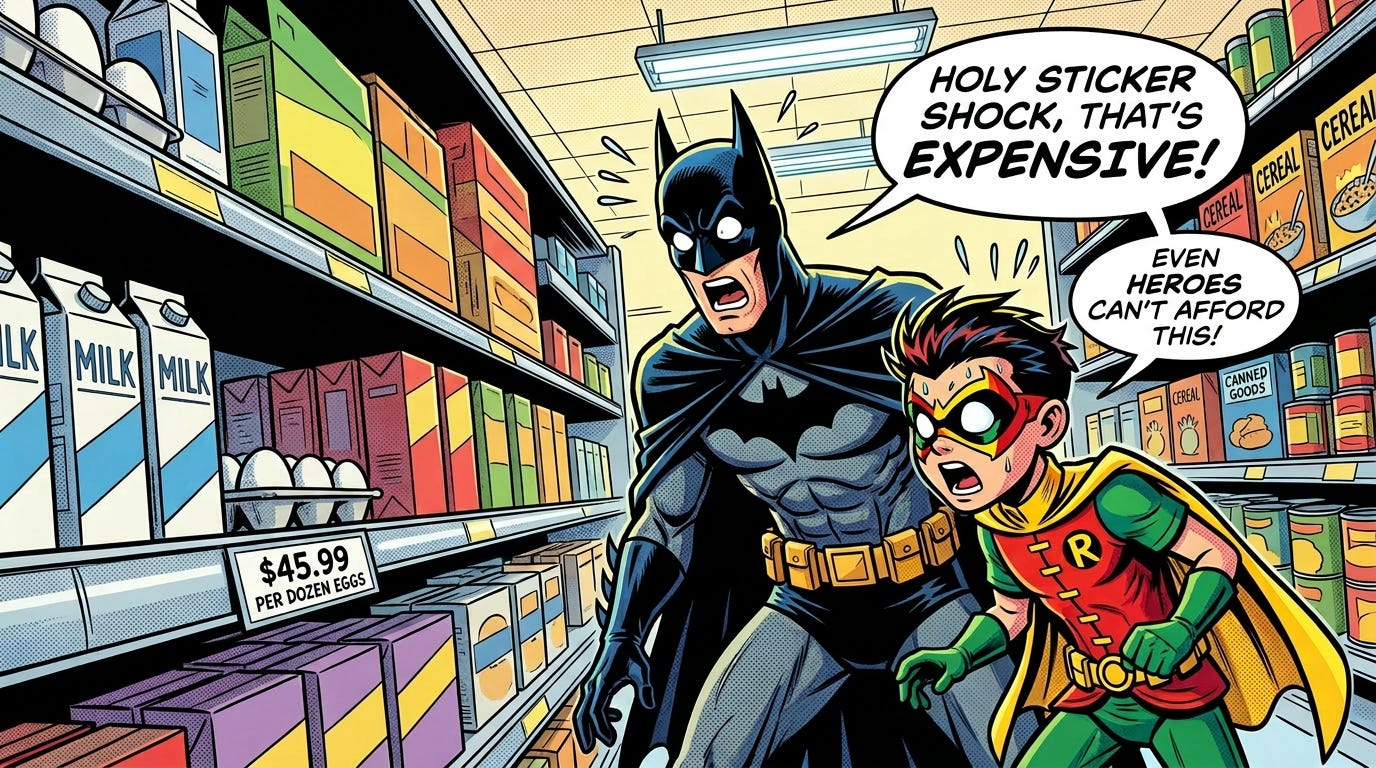
Holy Sticker Shock, Batman!
You know how stores have traditionally labeled items on the shelves with set prices so shoppers know precisely what those items cost? Yeah, no more of that. Instead, retailers have begun applying an innovative approach called “dynamic pricing” that, according to one source I found, “allows businesses to adjust the prices of products or services in real-time based on fluctuating market conditions, such as supply and demand, inventory levels, competitor pricing, and customer behavior.”
I particularly appreciate the use of the word “dynamic,” which many of us associate with the exploits of Batman and Robin. Not only does the term inject a level of excitement into the act of buying a can of soup, but “dynamic pricing” also has a better ring to it than the traditional term, “price gouging.”
And that’s all it is, really. Companies are basically using algorithms and other information sources to determine the highest possible amount shoppers will pay for an item and then “dynamically” setting the prices accordingly.
Before long we’ll reach the point where pharmacies will identify someone coming in the door rubbing their temples and automatically jack up the price on pain relievers. Or what about the desperate-looking dad who stumbles in at 2:00 am seeking to buy the store’s only remaining pack of diapers? “That’ll be $1,000 please.” It’s enough to make you want to take a dynamic swing at someone!
One wonders whether there’s a tipping point where we collectively decide we’ve had enough of shrink-flation, planned obsolescence, dynamic pricing and all the other as-yet-undiscovered ways corporate America will come up with to irritate us (cough, AI chatbots, cough).
At that point we may realize that beyond our basic needs, we’re much better off rejecting rampant consumerism and instead committing to spending our money on those areas of life that truly matter: friends and family, building community, getting out in nature, travel, and, of course, subscriptions to our favorite Substack writers.
Damn free market economy!
Inflation is caused by one thing - MONEY PRINTING. Money and government should be separate, the way it was intended.
In 1971, Nixon took the United States Dollar off the gold standard. That began the slow decline of our way of living and normalized inflation.
Bitcoin fixes this.